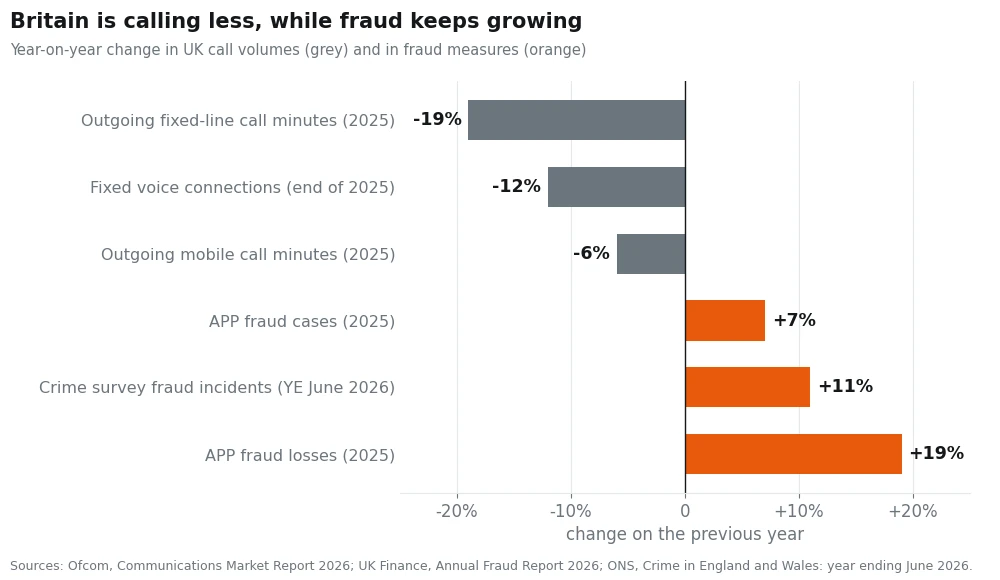
The UK made 164 billion minutes of outgoing phone calls in 2025, 7% fewer than the year before, and landlines lost almost a fifth of their outgoing minutes. On paper, the phone is fading. In the fraud figures it is doing the opposite. According to UK Finance, only 17% of bank transfer scams in 2025 started with a call or a text, but they accounted for 28% of the money lost. Our thesis: Britain is calling less, but the call has become the fraudster's premium channel, used less often and for bigger sums, and since October 2024 most of that bill lands on the banks rather than the victims. We put together the public data from Ofcom, UK Finance, the Office for National Statistics and the Payment Systems Regulator and did the sums.
The phone starts fewer scams, but the expensive ones
The main source is the UK Finance Annual Fraud Report 2026, published in June 2026. It covers authorised push payment (APP) fraud, where you are tricked into sending money yourself. In 2025 APP losses rose by 19% to £576.4 million, across 248,070 cases (up 7%). UK Finance also records where each case began. 66% of cases started online, but they produced only 32% of losses. 17% of cases began on telecoms networks and produced 28% of losses, which UK Finance describes as "typically involving higher value scams".
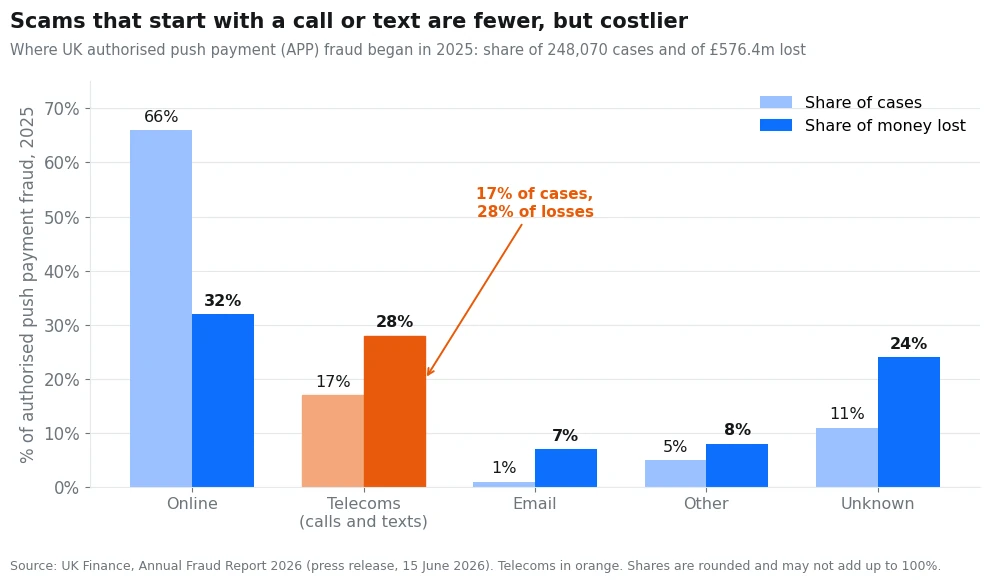
Put into pounds, that is about £161 million lost to scams that began with a call or a text in a single year, across roughly 42,000 cases. The average telecoms case cost about £3,800, against about £1,100 for a case that began online, so a scam that starts on the phone network costs around 3.4 times more (our calculation). Spread over the year, that is about 115 cases and £440,000 every day (our calculation). In 2024 the telecoms share of cases was 16%, so the channel is not shrinking.
The mix of scams explains part of the gap. Purchase scams, where you pay for goods that never arrive, made up 71% of all APP cases but lost "only" £118.1 million, about £670 a case (our calculation). The big money sits elsewhere: investment fraud took £221.5 million (up 40%) from 14,893 cases, and romance fraud £39.2 million (up 23%). Impersonation fraud, the classic call from the "bank" or the "police" asking you to move money to a "safe account", fell again in 2025, with losses down 12% and cases down 11%. UK Finance does not publish which channel each type of scam starts on, so we can't say how many investment scams began with a call.
The Crime Survey for England and Wales gives the view from the victim's side. In the year to June 2026 it estimated 4.5 million fraud incidents, up 11%, out of 9.7 million incidents of headline crime. Fraud is now close to half (46%) of the crime the survey measures against people and households (our calculation). In most frauds the criminal never contacts the victim at all (79% of incidents in the year to March 2025, and 90% of bank and credit account frauds). But when there was contact, the first contact was a telephone call in 39% of cases, ahead of online (32%), email (13%), in person (9%) and text message (4%).
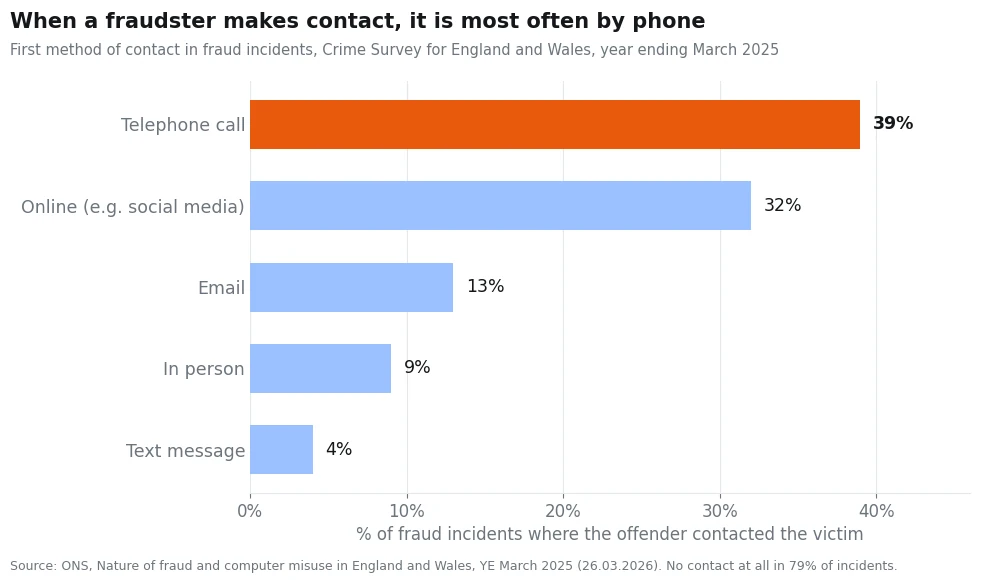
Applied to the 4.2 million incidents in that survey year, the percentages suggest roughly 340,000 frauds that began with a phone call, close to 940 a day (our calculation, an order of magnitude because the survey publishes rounded shares). That is far more than the 42,000 telecoms cases in the bank data, because the survey also counts small frauds and losses that never reach a bank's fraud team.
Britain talks less, but still picks up a UK mobile
Ofcom's Communications Market Report 2026 shows how quickly the voice call is shrinking. Outgoing call minutes fell by 7% to 164 billion in 2025. Fixed lines fell by 19% to 15 billion minutes and mobiles by 6% to 149 billion, so 91% of call minutes now start on a mobile network. The average mobile subscription made 146 minutes of calls a month, about 4.8 minutes a day (our calculation). At the end of 2025 there were 21.4 million fixed voice connections, 2.8 million fewer than a year earlier. Of these, 12.9 million were mainly managed VoIP lines over broadband, which leaves about 8.5 million PSTN or emulated PSTN lines and ISDN channels still to move (our calculation). We covered what the copper switch-off means for you in our guide to the UK landline switch-off.
Fewer calls should mean fewer chances for a scammer. The catch is in what people do with an unknown number. In Ofcom research from February 2025, 42% of phone users said they had received a suspicious call in the previous three months. A quarter (26%) said they were likely to pick up a call from an unrecognised UK mobile number, but only 9% would answer an unrecognised international number. A +447 number on the screen is almost three times as likely to be answered (our calculation), and that is exactly why criminals abroad fake one.
The regulator has been closing that door one number type at a time. In 2024 Ofcom told providers to identify and block calls from abroad that falsely show a UK landline number, and in July 2025 it said that work had led to a million calls a day being blocked. On 15 July 2026 it extended its guidance to UK mobile numbers: calls from abroad that show a +447 number should have the caller ID withheld unless the provider can verify it. On the same day it finalised rules for scam texts. Mobile operators already block an estimated 600 million scam messages a year, yet in February 2026 four in ten mobile users (40%) still said they had received a suspicious message in the previous three months. How spoofing works is explained in our article on caller ID spoofing in the UK.
| Indicator | Value | Source, period |
|---|---|---|
| Outgoing call minutes (fixed and mobile) | 164 billion, -7% | Ofcom, 2025 |
| Fixed voice connections | 21.4 million, -12% | Ofcom, end of 2025 |
| Phone users with a suspicious call in the last 3 months | 42% | Ofcom, February 2025 |
| Likely to answer an unknown UK mobile / international number | 26% / 9% | Ofcom, February 2025 |
| APP fraud losses | £576.4 million, +19% | UK Finance, 2025 |
| APP cases that began on telecoms networks | 17% of cases, 28% of losses | UK Finance, 2025 |
| Fraud incidents, Crime Survey for England and Wales | 4.5 million, +11% | ONS, year to June 2026 |
| In-scope APP money reimbursed | 88% (£316 million) | PSR, Oct 2024 - Mar 2026 |
Who pays for a convincing call
Since 7 October 2024 banks and payment firms must reimburse most victims of APP fraud. The Payment Systems Regulator rules cover individuals, microenterprises and charities paying by Faster Payments or CHAPS, up to £85,000 per claim, with an optional excess of up to £100, and you have 13 months to report. The exception is if you were complicit or grossly negligent, which the PSR calls "a high bar".
The PSR's dashboard, updated on 30 July 2026, shows how this works in practice. In the 18 months from 7 October 2024 to 31 March 2026, 88% (£316 million) of the money lost to in-scope APP scams was reimbursed. Consumers reported around 438,300 claims, of which 301,500 were in scope, about 810 claims a day (our calculation). 82% of claims were closed within five business days and only 3% were rejected because the customer had not taken enough care. In the first quarter of 2026 the reimbursement rate was 89%, with £72.6 million paid back, the highest quarterly sum so far.
UK Finance measures more widely, including payment types and accounts outside the PSR rules. On its figures, banks reimbursed £354.3 million of APP losses in 2025, or 61%. That still leaves about £222 million that stayed with victims in 2025 (our calculation), for example above the cap, in civil disputes or on payments the rules don't cover.
In our view, these numbers tell a story the headlines miss. The reimbursement rules have quietly moved most of the cost of a persuasive phone call from the person who answered it to the bank that sent the money. That is fair to victims, and the PSR sees no sign that people have become careless. But it also means the industry that carries the call is not the one that pays for it. UK Finance itself argues that tech and telecoms firms should contribute financially. Ofcom's mobile spoofing guidance is the most direct fix in the data, because it targets the 26% who pick up a "UK mobile". We think it will cut the cheapest trick, the fake +447 from abroad, but not the scam call made from a real UK SIM or the one that starts on social media and moves to the phone later. The link between falling call volumes and pricier phone scams is our reading of the figures, not a conclusion of Ofcom, UK Finance or the ONS.
The practical rule follows from it. A number on the screen is a claim, not a proof. If a call is about money, hang up and ring 159 to reach your bank, or call the number on your card. Forward scam texts and the numbers of scam callers to 7726. If you have paid, tell your bank straight away and report it to Report Fraud on 0300 123 2040 (Police Scotland on 101 in Scotland).
Frequently asked questions
How much money is lost to phone scams in the UK?
UK Finance does not publish a separate "phone" total. In 2025, APP scams that began on telecoms networks made up 28% of £576.4 million in losses, about £161 million (our calculation). Telecoms here covers calls and texts together.
How many frauds start with a phone call?
In the Crime Survey for England and Wales for the year to March 2025, a telephone call was the first method of contact in 39% of the fraud incidents where the offender contacted the victim. Across all 4.2 million incidents that is roughly 340,000 frauds (our estimate).
Do banks refund scam victims?
Mostly, for bank transfers. Under the PSR rules, 88% of the money lost to in-scope APP scams was reimbursed between October 2024 and March 2026. The limit is £85,000 per claim, and you should report within 13 months.
Are scam calls from abroad blocked?
Calls from abroad that fake a UK landline number should be blocked under Ofcom's guidance. Under guidance Ofcom finalised in July 2026, calls from abroad that show a UK mobile number should appear as withheld unless the provider can verify them.
The bottom line
The UK is making fewer phone calls every year, 164 billion minutes in 2025 and falling, but the call has not lost its value to fraudsters. Scams that start on telecoms networks are one in six bank transfer frauds and more than a quarter of the money, about £3,800 a case against £1,100 for one that starts online. When a fraudster has to make contact, a phone call is still the most common way in. Banks now refund most of the loss under the PSR rules, and Ofcom is taking fake UK numbers away from callers abroad, but a familiar-looking number still proves nothing about who is on the line.
Methodology and sources
We used only public data from UK bodies. We did not use any data collected on Who Rang.
- We checked the figures in the original publications: the UK Finance press releases for the Annual Fraud Reports 2026 and 2025, the ONS bulletin and article (PDF), the Ofcom Communications Market Report 2026 (PDF) and Ofcom news pages, and the PSR dashboard and consumer page.
- "Our calculation": telecoms losses (28% x £576.4m); telecoms cases (17% x 248,070); average per case, telecoms (£161.4m / 42,172) and online (32% x £576.4m / 66% x 248,070), and the ratio between them; per day (42,172 / 365; £161.4m / 365); fraud share of headline crime (4.5m / 9.7m); purchase scams per case (£118.1m / 71% x 248,070); frauds starting with a phone call (4.2m x 21% x 39%, and / 365); minutes per day (146 / 30.4); lines left to migrate (21.4m - 12.9m); answer ratio (26% / 9%); PSR claims per day (438,300 / 541 days); losses left with victims (£576.4m - £354.3m).
- Limits: UK Finance shares are rounded to whole percentages, so the per-case averages are approximate (about £3,650 to £4,000 for telecoms). "Telecoms" combines calls and texts. UK Finance counts cases by account, not by person, and covers more payment types than the PSR rules, so the 61% and 88% reimbursement rates are not comparable. The crime survey covers England and Wales only and its estimates carry sampling error.
Sources: UK Finance, Annual Fraud Report 2026, press release (15.06.2026); UK Finance, Annual Fraud Report 2025, press release (28.05.2025); ONS, Crime in England and Wales: year ending June 2026 (22.10.2026, sections 1 and 15); ONS, Nature of fraud and computer misuse in England and Wales: year ending March 2025 (26.03.2026, section 4); Ofcom, Communications Market Report 2026 (30.06.2026, key findings, telecoms); Ofcom, Cracking down on scam calls from abroad (21.07.2025); Ofcom, Statement: Tackling scam calls from abroad (15.07.2026); Ofcom, New rules to thwart text message scammers (15.07.2026); Payment Systems Regulator, APP scams reimbursement dashboard for Q1 2026 (30.07.2026); Payment Systems Regulator, APP fraud reimbursement protections.
We will update this page when UK Finance and the PSR publish their next figures. Last updated: 15 November 2026.